

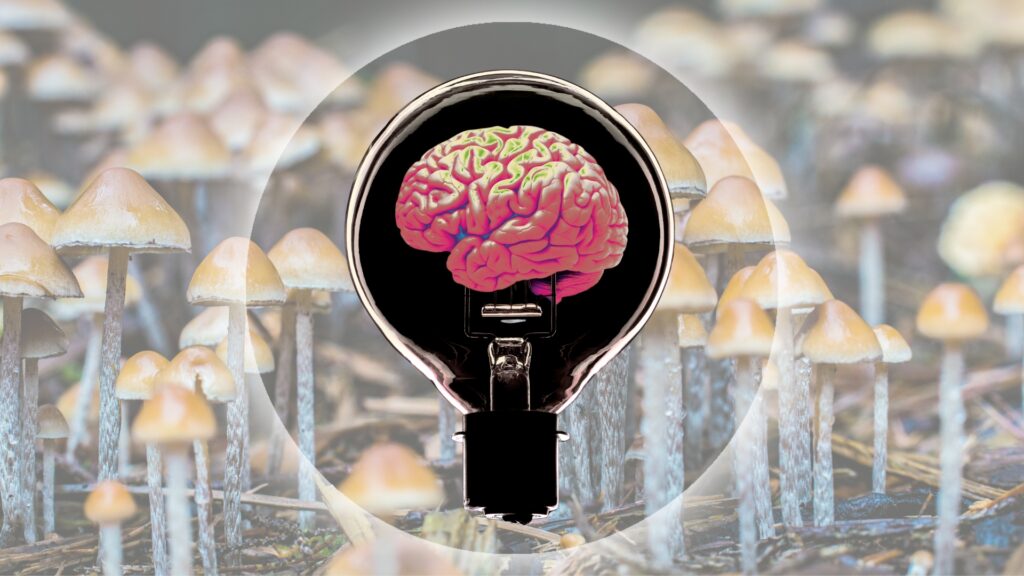
New research from Northeastern University suggests that psilocybin may help repair brain function after mild, repetitive head injuries.
Over a million Americans experience a traumatic brain injury (TBI) each year. Frustratingly, there are limited medical treatments for these injuries. While ongoing clinical trials investigate different pharmaceutical options for treating TBIs, psilocybin (the active compound in ‘magic mushrooms’) is making significant strides in a more… technicolor fashion.
Preliminary research conducted by Northeastern University tested the effects of psilocybin on rats after a head injury, leaving Northeastern psychology professor Craig Ferris ‘stunned’ by the study’s results.
In a preprint of the study, published in bioRxiv, the researchers designed the head injuries inflicted on the rat subjects to mirror those commonly associated with athletes, the elderly, and military personnel. The result? Reduced inflammation, increased neuroplasticity, and restored brain connectivity that even surpassed normal levels after psilocybin treatment.
“What we found was that with head injuries… functional connections go down across the brain. You give the psilocybin and not only does it return to normal, but the brain becomes hyper connected.” said Ferris. However, this would not be the first time psilocybin has displayed its remarkable ability to rewire or restore brain function, though.
Scientists and UC San Francisco and Imperial College London tested psilocybin on human subjects with moderate-to-severe treatment-resistant depression, using fMRI brain scans before and after treatment to assess its effects on the brain and its efficacy as a depression treatment in comparison to common SSRIs. The scans revealed not only that psilocybin treatment dampened overconnected brain areas linked to depression, such as the default mode network (DMN) and salience network (SN), but actually strengthened connections to previously unintegrated regions. Post-treatment, participants displayed stronger emotional availability and improved cognitive function—results not seen in the escitalopram (SSRI) group.
All to say, psilocybin is piquing impressive scientific interest across various fields, with preliminary findings on TBIs prompting researchers to explore its potential as a preventative treatment for brain injuries before they lead to chronic issues.
Fellow advocate and artist Kyle Anderson may not have participated in clinical studies to prove the transformative effects of psilocybin, but has instead embarked on his own journey with psychedelics, spanning over two decades since emerging from the shadows of his own traumatic brain injury.
K: “I was an elite snowboarder in 2005, and flew off a jump going sky high. I struck my head as I came crashing down on the hill, causing a Traumatic Brain Injury. New life began right then.”
Two decades post-traumatic injury, Kyle Anderson recounts not only the physical consequence of his injury including wheelchair-bounding inflictions, but the frustrations that uprooted from a series of pharmaceutical interventions that seemed to cause more harm than good in his quest for help.
K: “I turned to mushrooms after dealing with all kinds of pharmaceutical drugs that doctors were shoving down my throat, and I began to feel unreal. Amazing, even.”
Psychedelics like psilocybin are thought to impact the brain by reducing inflammation—a primary cause of damage when TBIs occur. When inflammation in the brain seizes to reduce, the person then becomes susceptible to further neuron damage. Fascinatingly, psilocybin actually stimulates neurotrophic factors in the brain, a brain protein responsible for the recovery and growth of damaged neurons.
In a 2021 National Geographic article, integrative rehabilitation medicine physician Sunil Aggarwal refers to psychedelics as “a different paradigm” in the treatment of traumatic brain injury (TBI). He elaborates, stating that “[psychedelic drugs] rely a lot more on the body’s innate healing capabilities, and stimulate that process to occur more robustly,” in contrast to pharmaceutical options, which require daily ingestion to maintain their effect.
K: “If it wasn’t for psilocybin, I wouldn’t be here today. I’ve faced it all, so much depression to attempting suicide for an example. It has allowed me to transcend my past and embrace a future filled with all the love and so many possibilities”
Flash forward to today, Kyle has reclaimed his passion for life through the “newfound cognitive clarity” from psilocybin, alongside various fulfilling pursuits like music, comedy, and authorship. While Kyle acknowledges that the journey has not been without its difficulties, nor has psilocybin assumed the title of a “quick fix” in his journey, Kyle better explains the process as a resilience built over time, resulting in a series of invaluable outcomes.
K: It’s helped 100% in beating my depression, and helped huge with my speech. Whenever I face a headache, I microdose. I am no longer confused, as everything you’re thinking, becomes clear. It’s made me the happiest and the funniest version of myself, no longer caring about others who “judge” me. These are brought by nature, and tests are being conducted with profound results.
While psilocybin-research regarding TBI treatment is still limited, nor has it emerged as an objective fix, experts remain inclined by the potential at hand.
Kyle’s inspiring story of discovering psilocybin in his TBI healing journey is just one of many inspiring others across the country. UFC fighter Ian McCall, whose traumatic head injury abruptly ended his 16-year fighting career, credits psilocybin with transforming his life. Now an avid microdoser, he is also the creator of the ‘McCall Method’, a psychedelic integration method for high-level athletes and performers.
McCall’s journey mirrors that of another renowned former athlete, ex-Chicago Blackhawks player Daniel Carcillo, who founded a first-of-its-kind psilocybin center for athletes and veterans with traumatic brain injuries. “I experienced firsthand what the medical system could and couldn’t offer for brain injuries and mental health. Psilocybin not only saved my life but gave me a renewed purpose,” Carcillo wrote in a recent Instagram post, reflecting on his post-injury journey.
K: Research is important, but more than that, experience is far better once it’s done. And don’t be someone who only tries a few times—if you really want to heal yourself, you have to commit, because in some way, we’re all traumatized.
While every journey is unique and TBI research is ongoing, psilocybin is making groundbreaking strides, transforming lives in areas ranging from brain injury recovery to mental health.