

Coherence has a real physiology under it, and it helps to know where that ends. Breathing at around six breaths a minute produces a large, smooth, almost sine wave swing in heart rate, driven by the baroreflex, and that pattern is well documented in independent labs. The claims stacked on top, about energetic fields and planetary signals and heart-brain coherence as established science, are not. Here is where the line sits.
What we are actually measuring
Heart rate variability is the variation in time between one heartbeat and the next. Shaffer and Ginsberg open their review of it with the line that does most of the work. “A healthy heart is not a metronome.”
The measure quoted most often is RMSSD, “the root mean square of successive differences between normal heartbeats”, called there “the primary time-domain measure used to estimate the vagally mediated changes reflected in HRV”. By frequency, the high band of 0.15 to 0.40 Hz sits in the respiratory range and reflects parasympathetic activity, while low frequency runs 0.04 to 0.15 Hz. Across 44 studies and 21,438 healthy participants, mean five minute RMSSD was 42 ms, standard deviation 15, with a range of 19 to 75 ms.
One reading off a wearable tells you little, because plenty moves the number.
- Time-domain HRV declines with age, and RMSSD follows a U-shaped pattern, falling from 40 to 60 and rising again after 70.
- Women show greater high frequency power than men.
- Time-domain measures rise with aerobic fitness.
- Changing your respiration rate alters the measures directly.
That last one decides everything else. Quintana and Heathers put it plainly. “both breathing and blood pressure regulation have their own relationship to social, emotional, and cognitive experiments, if this is the case are we observing heart rate (HR) changes as a consequence of breathing changes?” When somebody shows you HRV going up, ask what the breathing was doing.
Thayer and colleagues pooled neuroimaging coordinates and found significant associations between HRV and activity in the amygdala and the ventromedial prefrontal cortex.
Six breaths a minute is ground you can stand on
Breathe slowly enough and your heart rate starts to swing in a large wave that follows the breath. Lehrer and Gevirtz put the sweet spot at “approximately 0.1 Hz (six breaths per minute)”, refined in the same paper to “about 0.09 Hz, or 5.5 breaths per minute, with breath duration of about 11 s.” The driver is the baroreflex. “When the system is stimulated at the specific frequency causing maximum heart rate oscillations and a 180 degree phase relationship between heart rate and blood pressure, effects of the stimulator are compounded by effects of the baroreflex.”
Your own rate varies. Vaschillo and colleagues paced five untrained healthy men across seven frequencies and found the highest oscillation amplitudes “in the range of 0.055 to 0.11 Hz”, roughly 3.3 to 6.6 breaths a minute. A later study of 32 adults with asthma and 24 healthy adults found lower resonant frequencies in taller people and in men, no relationship to age, weight or asthma, and a rate that held constant across ten sessions.
Sevoz-Couche and Laborde give the defensible version of the word, framing the mechanism as slowing the breath towards the resonant frequency of around 0.1 Hz, achieved “through temporal coherence of respiratory, blood pressure, and cardiac phases”. Rhythms lining up in time, measurable and unmysterious.

What the evidence adds up to
Zaccaro and colleagues screened 2,461 abstracts for a review of slow breathing, ten breaths a minute or fewer, and found 15 qualifying articles, some with nine or ten people. HRV and respiratory sinus arrhythmia tended to increase, though not uniformly. The psychological picture was steadier, with more comfort and less anxiety. No pooled effect sizes are reported, because the studies never linked the physiology to the feeling. Laborde and colleagues screened 1,842 abstracts, included 223 studies, and found increases in vagally mediated HRV during practice, after one session, and after a multi-session intervention.
Steffen and colleagues show how partial the effects can be, randomising 95 people to three groups for a 15 minute breathing period. The resonance frequency group showed a larger rise in the LF/HF ratio than control, F=4.64, p=0.01, more positive mood, F=10.73, p<0.001, and lower systolic blood pressure reactivity under stress, F=3.29, p<0.05. SDNN and RMSSD showed no significant group differences over time.
The shape of the breath matters as much as the rate. Van Diest and colleagues had 30 people breathe four patterns, crossing six or twelve breaths a minute with an inhale-to-exhale ratio of 0.42 or 2.33. The low ratio, meaning a longer exhale, drove the subjective effect. Slowing the rate alone only raised positive energy.
Goessl and colleagues meta-analysed 24 studies and 484 participants, finding a Hedges g of 0.81 for HRV biofeedback pre to post and 0.83 versus control, unmoderated by session count. Lehrer and colleagues later included 58 randomised controlled studies and concluded that “A significant small to moderate effect size was found favoring HRVB, which does not differ from that of other effective treatments.” A separate trial of 112 people, breathing slowly with or without biofeedback, found both conditions lowered emotional arousal and raised RMSSD. The hardware added little.
Across breathwork trials, Fincham and colleagues found small effects. Stress improved across 12 trials and 785 participants, g of -0.35, 95% CI -0.55 to -0.14, p=0.0009, with anxiety at -0.32 across 20 trials and depression at -0.40 across 18. Their caveat is the most honest line here. “Most studies were deemed as being at moderate risk of bias”, and the authors “urge caution and advocate for nuanced research approaches with low risk-of-bias study designs to avoid a miscalibration between hype and evidence.”
Why the bigger claims are so appealing
Most popular language around coherence traces back to the HeartMath Institute, and it is easy to see why. It puts a name and a number on a feeling, and their physiology holds up. McCraty and Zayas write that “Physiological coherence is reflected in more ordered and sine wave-like HRV patterns at a frequency of around 0.1 Hz (10 seconds rhythm)”, showing “a very narrow, high-amplitude peak in the LF region.” Their coherence ratio is computable, peak power divided by total power minus peak power. That pattern is real, and it is the same baroreflex resonance described by Lehrer, Vaschillo and Sevoz-Couche, none of them HeartMath affiliated.
In a paper on the Global Coherence Initiative, McCraty, Deyhle and Childre write that “The convergence of several independent lines of evidence provides strong support for the existence of a global information field that connects all living systems and consciousness”, and that “A primary goal of GCI is to test the hypothesis that large numbers of people when in a heart-coherent state and holding a shared intention can encode information on the earth’s energetic and geomagnetic fields.” The authors call that a hypothesis they intend to test. It ran in an alternative medicine journal, with no independent replication. An exact-phrase PubMed search for “heart-brain coherence” returns one indexed record, from the same institute.
A peer-reviewed critique rarely gets quoted. Houtveen and colleagues tested two assumptions behind heart coherence training, that poor mental health is definitively linked to deviant HRV, and that optimising HRV reduces symptoms. “There is insufficient evidence to support these two assumptions.” They concluded that “Slow breathing and heart coherence training probably achieve their effects as a result of non-specific psychological mechanisms.” A practice can still do you good while its proposed mechanism stays unproven, and a coherence score that gets you sitting down each day has done the work that matters. The heart and brain talk in both directions, which is interesting enough without promoting one to leader.
What meditation does, and where the evidence stops
Goyal and colleagues reviewed 18,753 citations and kept 47 randomised trials with active controls, 3,515 participants. Mindfulness meditation showed moderate strength of evidence for anxiety, 0.38, 95% CI 0.12 to 0.64, at eight weeks and 0.22 later, depression 0.30 then 0.23, and pain 0.33. Two findings there get left out of most wellness writing, and we would rather you had them. “We found low evidence of no effect or insufficient evidence of any effect of meditation programs on positive mood, attention, substance use, eating habits, sleep, and weight.” And “We found no evidence that meditation programs were better than any active treatment (ie, drugs, exercise, and other behavioral therapies).”
Then the finding that changed how we write about this. Brown and colleagues meta-analysed 19 randomised trials asking whether mindfulness and meditation interventions raise vagally mediated resting-state HRV. They were not efficacious in doing so, Hedges g of 0.38, 95% CI -0.014 to 0.77, crossing zero. Removing one outlier gave 0.19, CI -0.02 to 0.39, still non-significant, heterogeneity 89.12%. “There is currently insufficient evidence to indicate that MBIs lead to improvements in vagally mediated HRV over control conditions.” Slow-paced breathing raises HRV during and just after practice. Sitting meditation has not been shown to raise resting HRV.
The study everyone reaches for needs a footnote, and we understand why. Kok and colleagues randomised 65 people to loving-kindness meditation or a waiting list and reported positive emotions raising vagal tone through social connection. Heathers and colleagues reanalysed it. Kok’s own supplemental analysis gave t(36)=-1.93, p=.06, and correcting for an unexplained negative change in the control group’s high frequency HRV the effect vanished, t=-0.89, df=35, p=.37, and a logarithmic transformation gave t=1.06, df=43, p=.30. Respiration was never monitored, and one participant went from a baseline HF-HRV of 239 to 10,600 ms squared per Hz, “almost certainly evidence of an altered respiratory pattern, rather than increased vagal tone.”
Where mushrooms fit
As of 24 August 2026, a PubMed search for psilocybin and heart rate variability returns zero records. No psilocybin study has measured HRV, RMSSD, high frequency power or a coherence score. So the claim that psilocybin creates heart-brain coherence is running ahead of a study nobody has run.
Psilocybin alongside meditation has been studied carefully. Smigielski and colleagues ran a randomised, double-blind, placebo-controlled study of 38 people given 315 micrograms per kilogram during a five day mindfulness retreat, and found changes in self-referential regions of the default mode network. “Decoupling of medial prefrontal and posterior cingulate cortices, which is thought to mediate sense of self, was associated with the subjective ego dissolution effect.” That predicted better psycho-social functioning four months on.
A companion paper followed 39 experienced meditators through the same retreat, 20 on psilocybin and 19 on placebo. Trait mindfulness was higher on psilocybin, p<0.001, and meditation depth rose from 63.0 to 77.7. Mystical-type experience meeting the study’s criteria hit 19 of 20 on psilocybin and 3 of 19 on placebo. At four months, Life Changes Inventory Revised scores were 0.75 versus 0.19, F(1,37)=23.41, p<0.0001.
The detail worth carrying is from Griffiths and colleagues, who randomised 75 healthy people to a very low dose with standard spiritual-practice support, a high dose with standard support, or a high dose with high support. At six months, the share meditating daily was 32 percent in the low-dose control, 20 percent on the high dose with standard support, and 64 percent with high support, at 10.23, 9.93 and 19.33 minutes a day. The behaviour change tracked the support rather than the dose.
For microdosing, Marschall and colleagues ran a preregistered, double-blind, placebo-controlled crossover study of exactly the outcomes an article like this would want. Microdosed psilocybin did not affect self-reported interoceptive awareness, emotion processing, anxiety or depression against placebo. A microdose is subtle yet noticeable, and what you notice is a separate question from what a trial can measure.
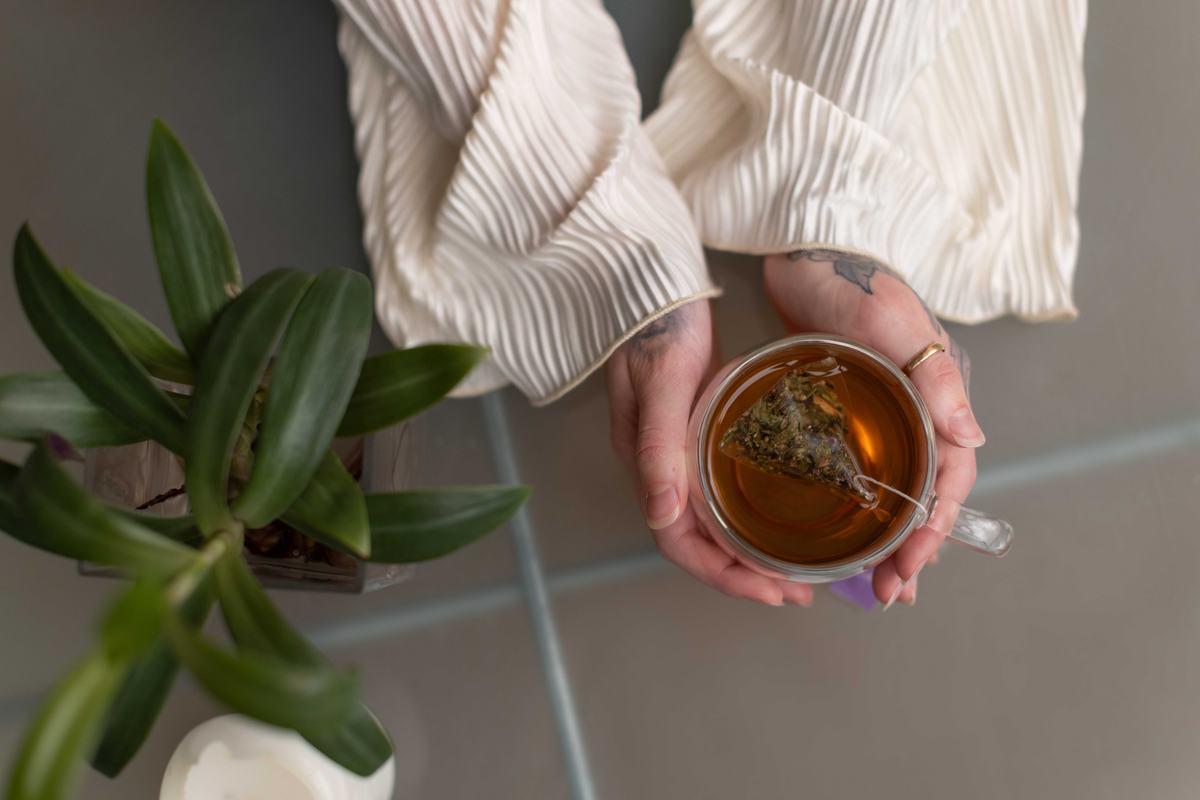
A mushroom earns its place in the ritual around the practice. Our Longevity Tea is caffeine free, 70mg of Golden Teacher a bag and twelve bags to a box, a ten minute preamble rather than a stimulant working against you. For daytime, Neuro-Blend Capsules pair Lion’s Mane with Golden Teacher across 30 capsules. Neither has been shown to move your RMSSD, and the breathing has. If you are working out where to begin, we set out the differences between microdosing and macrodosing plainly.
A practice to take with you
The breath
Four seconds in, six seconds out. That is an inhale-to-exhale ratio of 0.67, on the long-exhale side that Van Diest found mattered, and it lands you at six breaths a minute. Breathe through the nose, quiet and unforced, belly rather than chest. If four and six feels strained, three in and five out is 7.5 a minute. Ten minutes, twice a day. That is the whole of it.
Finding your own number
Resonance frequency is a property of your body rather than a skill. Taller people and men tend to sit lower, while age and weight have no effect on it. Vaschillo’s paced trials spanned roughly 3.3 to 6.6 breaths a minute. Start at six, try either side over a few weeks, and keep the rate that leaves you settled with no air hunger. Your body knows before any device does.
What to expect, and when
Here are the honest timings.
- During the session, HRV rises while you breathe slowly. Most of the 223 studies in the Laborde meta-analysis measured this window.
- Within about fifteen minutes, mood and blood pressure reactivity can shift, as in the Steffen trial.
- Straight after one session, emotional arousal drops and RMSSD rises, screen or no screen.
- Around ten days, day and night HRV rose in the Kirk and Axelsen mindfulness group, though acute rises during practice showed up in their music-listening control too.
- At eight weeks, the Goyal effect sizes are the ceiling for anxiety, depression and pain.
- At roughly three months of twice-daily practice, resting baroreflex gain changed in the Lehrer and Gevirtz work.
Two meta-analyses found session count did not predict benefit, which is freeing. No study establishes that five minutes a day produces measurable change, so treat any promise built on that number as decoration. You do not need a ring or a chest strap. If a reading makes you tense while you are settling, put it down and come back to the breath.
Holding both things at once
Slow breathing at around six breaths a minute produces a large, well-replicated change in cardiovascular rhythm, and it reliably makes people feel calmer while they are doing it. Whether that pattern is the reason they feel better remains unsettled. Meditation helps with anxiety, depression and pain at modest effect sizes, and has not been shown to raise resting HRV. Psilocybin has never been tested against an HRV outcome.
None of that makes the practice less worth doing, and none of it makes you naive for loving the bigger picture. Slowing your breath and giving your attention somewhere to rest has almost no downside and a small, repeatedly measured upside. It does not need a global information field to justify it. If you want a hand placing a mushroom alongside it, our short quiz is a good place to begin, or look through the full range.
Sources
- Shaffer F, Ginsberg JP. Frontiers in Public Health. 2017;5:258. https://pmc.ncbi.nlm.nih.gov/articles/PMC5624990/
- Thayer JF, Ahs F, Fredrikson M, Sollers JJ, Wager TD. Neuroscience and Biobehavioral Reviews. 2012;36(2):747. https://pubmed.ncbi.nlm.nih.gov/22178086/
- Quintana DS, Heathers JAJ. Frontiers in Psychology. 2014;5:805. https://pmc.ncbi.nlm.nih.gov/articles/PMC4106423/
- Lehrer PM, Gevirtz R. Frontiers in Psychology. 2014;5:756. https://pmc.ncbi.nlm.nih.gov/articles/PMC4104929/
- Vaschillo E, Lehrer P, Rishe N, Konstantinov M. Applied Psychophysiology and Biofeedback. 2002;27(1):1. https://pubmed.ncbi.nlm.nih.gov/12001882/
- Vaschillo EG, Vaschillo B, Lehrer PM. Applied Psychophysiology and Biofeedback. 2006;31(2):129. https://pubmed.ncbi.nlm.nih.gov/16838124/
- Zaccaro A, et al. Frontiers in Human Neuroscience. 2018;12:353. https://www.frontiersin.org/journals/human-neuroscience/articles/10.3389/fnhum.2018.00353/full
- Laborde S, et al. Neuroscience and Biobehavioral Reviews. 2022;138:104711. https://pubmed.ncbi.nlm.nih.gov/35623448/
- Laborde S, et al. Psychophysiology. 2022;59(1):e13952. https://pubmed.ncbi.nlm.nih.gov/34633670/
- Sevoz-Couche C, Laborde S. Neuroscience and Biobehavioral Reviews. 2022;135:104576. https://pubmed.ncbi.nlm.nih.gov/35167847/
- Steffen PR, Austin T, DeBarros A, Brown T. Frontiers in Public Health. 2017;5:222. https://www.frontiersin.org/journals/public-health/articles/10.3389/fpubh.2017.00222/full
- Van Diest I, Verstappen K, Aubert AE, Widjaja D, Vansteenwegen D, Vlemincx E. Applied Psychophysiology and Biofeedback. 2014;39(3-4):171. https://pubmed.ncbi.nlm.nih.gov/25156003/
- Goessl VC, Curtiss JE, Hofmann SG. Psychological Medicine. 2017;47(15):2578. https://pubmed.ncbi.nlm.nih.gov/28478782/
- Lehrer P, et al. Applied Psychophysiology and Biofeedback. 2020;45(3):109. https://pubmed.ncbi.nlm.nih.gov/32385728/
- Fincham GW, Strauss C, Montero-Marin J, Cavanagh K. Scientific Reports. 2023;13:432. https://pmc.ncbi.nlm.nih.gov/articles/PMC9828383/
- McCraty R, Zayas MA. Frontiers in Psychology. 2014;5:1090. https://pmc.ncbi.nlm.nih.gov/articles/PMC4179616/
- McCraty R, Deyhle A, Childre D. The global coherence initiative. Global Advances in Health and Medicine. 2012;1(1):64. https://pmc.ncbi.nlm.nih.gov/articles/PMC3833489/
- Houtveen JH, Hornsveld HK, van Trier J, van Doornen LJP. Tijdschrift voor Psychiatrie. 2012;54(10):879. https://pubmed.ncbi.nlm.nih.gov/23074032/
- Goyal M, et al. JAMA Internal Medicine. 2014;174(3):357. https://pmc.ncbi.nlm.nih.gov/articles/PMC4142584/
- Brown L, Rando AA, Eichel K, Van Dam NT, Celano CM, Huffman JC, Morris ME. Psychosomatic Medicine. 2021;83(6):631. https://pmc.ncbi.nlm.nih.gov/articles/PMC8243562/
- Kok BE, et al. Psychological Science. 2013;24(7):1123. https://pubmed.ncbi.nlm.nih.gov/23649562/
- Heathers JAJ, Brown NJL, Coyne JC, Friedman HL. The Elusory Upward Spiral, A Reanalysis of Kok et al. (2013). Psychological Science. 2015;26(7):1140. https://pubmed.ncbi.nlm.nih.gov/26025022/
- Kirk U, Axelsen JL. PLoS One. 2020;15(12):e0243488. https://pmc.ncbi.nlm.nih.gov/articles/PMC7746169/
- Smigielski L, Scheidegger M, Kometer M, Vollenweider FX. NeuroImage. 2019;196:207. https://pubmed.ncbi.nlm.nih.gov/30965131/
- Smigielski L, Kometer M, Scheidegger M, Krahenmann R, Huber T, Vollenweider FX. Scientific Reports. 2019;9:14914. https://pmc.ncbi.nlm.nih.gov/articles/PMC6813317/
- Griffiths RR, et al. Journal of Psychopharmacology. 2018;32(1):49. https://pmc.ncbi.nlm.nih.gov/articles/PMC5772431/
- Marschall J, et al. Journal of Psychopharmacology. 2022;36(1):97. https://pmc.ncbi.nlm.nih.gov/articles/PMC8801668/
This article is not intended to diagnose, treat, cure or prevent any disease.