

Nobody schedules a breakthrough. Insight arrives on its own timing, usually sideways, almost always once your attention has wandered off the thing you were trying to solve. Researchers have mapped the half second before an idea lands, right down to the timing of it. What decides whether it stays with you is the ordinary stretch of weeks afterward, and that stretch is yours to shape.
The moment before the moment
In 2004 Jung-Beeman and colleagues sat with people solving word puzzles. Some answers were worked out step by step. Some arrived with that sudden click, the one where you hear yourself say it before you quite know how you got there. Watching the two routes side by side, the researchers found the click had a signature of its own, a lift of activity over the right side of the brain that the step-by-step answers never showed.
The timing is the part that gets you. A burst appears about a third of a second before people speak. Their brains have the answer before they do. Whatever you are, you are running slightly behind yourself, and something in you knows the way out of a room before you have finished looking for the door.
Stranger still is what comes first. In the second or so before the burst, a slow wave rises over the back of the head and then falls away exactly as the answer arrives. Reviewing this work in 2014, Kounios and Beeman describe that wave as a kind of gating, a quieting of the noise coming in so that something faint and half formed has room to be heard. They compare it to closing your eyes, or looking away.
“reflects transient sensory gating that reduces noise from distracting inputs to facilitate retrieval of the weakly and unconsciously activated solution”
Which is a long way of saying what your body has been telling you for years. Faint things need quiet. You already look out the window when you are trying to remember a name, and you already close your eyes when someone asks you a question you actually care about.
Kounios and colleagues added one more thing in 2006, easy to miss and worth carrying with you. They could see, in the moments before a problem was even shown, which ones a person would go on to solve with that sudden click. The state you arrive in shapes what you find there. Not the effort you bring. The weather you bring.
The drifting is the part that works
Baird and colleagues gave 145 people a set of creative problems in 2012, then took the problems away for twelve minutes, then handed them back. During the gap everyone was sent somewhere different. Some were given something demanding to do. Some were given something easy and a little mindless. Some rested. Some went straight back to the problems with no break at all.
The ones who did the easy thing came back holding more answers. Not the ones who rested. That is the detail that keeps surprising people. Rest on its own did nothing much. It was the drifting that did it, that particular half-attending state where your hands are busy and your mind is off wandering the hallways.
Two details in that data are worth holding onto. The problems had to be loaded first, since the lift only showed on the ones people had already sat with. And the drifters were not quietly working. They reported thinking about the problems no more than anyone else did. Something was being sorted while they were somewhere else entirely, and they were not invited to watch.
You already know this in your body. The shower. The drive home. The long walk with nothing in your ears. What the research adds is that the empty chair does a different job than the moving feet, and if you have been sitting very still waiting for an answer to come, you might simply be sitting in the wrong place.
Giving the day somewhere to land
Some people come to this through a cleared day rather than a walk. In a carefully controlled trial, Mason and colleagues followed 60 people through a session and asked them, among many other things, how much a sense of spontaneous insight had arrived. That climbed sharply, and it climbed further than almost anything else they measured. Something about the day loosens how ideas sit next to one another, so that things you had filed in separate rooms turn out to share a wall.
The week that follows has its own soft weather. Ideas keep drifting in. Precision comes back slowly and on its own schedule. Plan around it rather than pushing through it. Clear the day after, not only the day itself. Leave the work that needs a fine point until the week has finished settling.
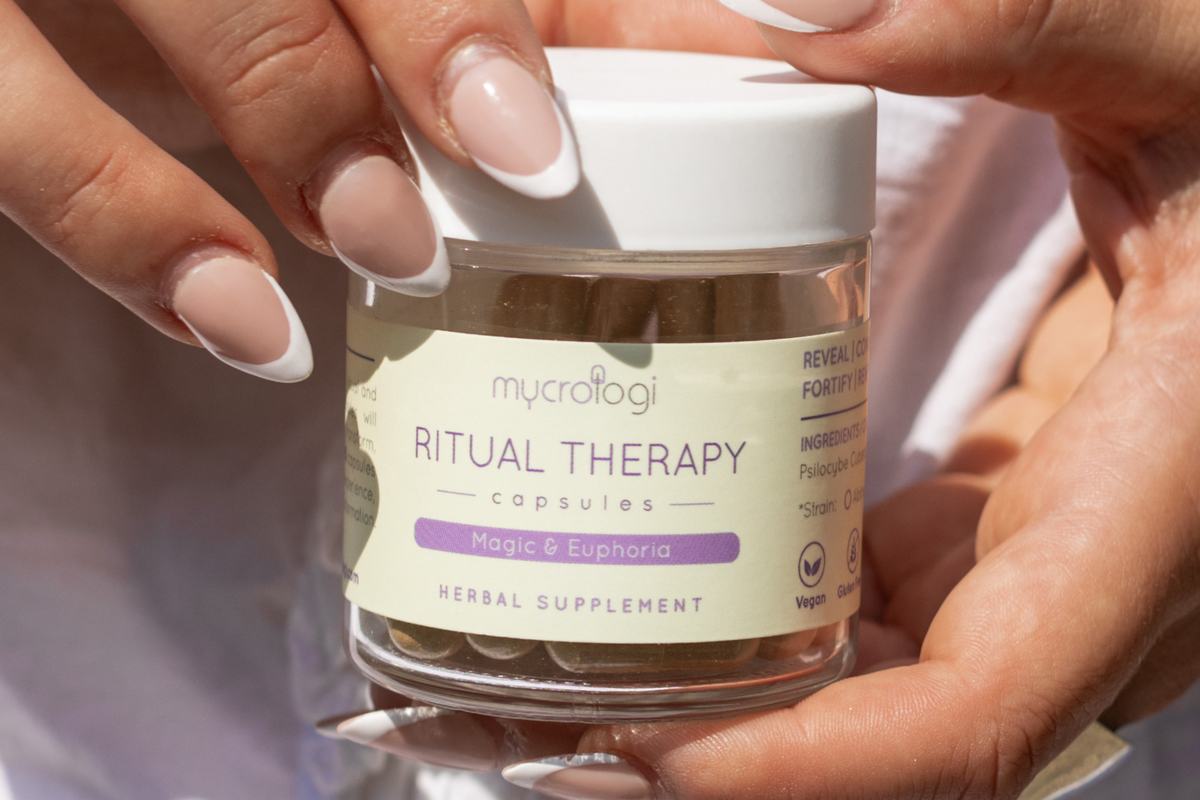
A day like that is worth building rather than squeezing in. Meet Ritual Therapy. The capsules start at $89 for 30 and are made for intentional journeys. Start with one, and give yourself somewhere soft to land.
The insight is the part that carries
Peill and colleagues wanted to know which part of a meaningful day actually travels with a person, so in 2022 they followed 886 people through one and then went back to them two weeks later. Then they did it again with another 279, because a thing worth believing is a thing that shows up twice.
What they found is quietly beautiful. The people who carried more insight out of the day were the ones feeling better a fortnight on. And the association ran strongest among the people who had walked in with the least, which is not how these things usually go. Whatever insight is doing, it seems to reach furthest toward whoever needed it most.
These are people describing their own lives to researchers rather than a laboratory measuring them, and that is worth saying plainly, because it is also what makes it feel true. Real days, real fortnights, real people going back to work on the Monday.
The path between the pieces is the part we keep thinking about. Emotional breakthrough, that moment where something long held finally moves, had the strongest link to insight of anything measured. And most of its effect on how people felt two weeks later travelled through insight to get there. The feeling opens the door. The understanding is what walks through it.
Davis and colleagues found something similar across 1,661 people in 2021. Insight predicted psychological flexibility, wellbeing and satisfaction with life, and it picked up something the older mystical measures had been walking straight past. Flexibility is the word that keeps recurring here, and it is a friendly one. Being able to hold your own life a little more loosely. Being able to set an idea down and pick up a different one.
What people still say a year later
Griffiths and colleagues followed 36 people for fourteen months after a single session. More than half rated the day among the five most personally meaningful experiences of their entire lives. Two thirds placed it among the five most spiritually significant. Two thirds said it had increased their wellbeing, and not one person rated it as having decreased.
Fourteen months on, none of that had faded. The ratings people gave at two months were the ratings they still gave over a year later, which is remarkable on its own, because feelings that strong usually soften as the year goes on. Something about that day stayed exactly where they had put it.
Why a date on the calendar helps
The date holds no power of its own. It simply hands you a clean line to stand on the other side of.
Dai, Milkman and Riis went looking for that line in three enormous piles of real behaviour. Searches for the word diet rose 14.4% at the start of a new week and 82.1% at the turn of a year. Undergraduate gym attendance rose 33.4% at the start of a new week. On a website where people make public commitments to themselves, across 43,012 of them, pledges clustered at exactly the same seams.
A Monday is enough. You do not have to wait for January, or for the first of the month, or for some version of yourself who has her life more together than you currently feel you do. The pattern reaches well past diet culture too, holding for goals about work, study and money just as readily. The authors think a landmark date lets a person set the previous stretch down and start counting from here, There is a reason a birthday makes you thoughtful.

September is full of those seams. That is probably why it feels the way it does. The light turns gold a little earlier. Everything slows half a step. The year begins quietly asking what you would like to do with the rest of it, and hands you about four clean lines to choose from before the month is out.
Catching an insight before it drifts off
What follows is where these lines of work seem to point, offered as company rather than instruction. Most of it you will recognise already.
- Write it down in the first rough sentence you can manage, before it turns tidy. The insight that predicted how people felt two weeks later was the insight they named on the day itself, not the polished version assembled afterward.
- Give yourself something light to do rather than a break. Folding the laundry. A walk on a route you could do with your eyes closed. Load the question first and then genuinely put it down, since the drifting only helped on problems people had already sat with.
- Protect the quiet, and do not feel strange about it. If that slow wave does what Kounios and Beeman think it does, faint ideas lose to loud rooms. Closing your eyes for one minute is a real practice, and it costs you nothing.
- Hang it on a date you already have. A Monday. A birthday. The first cool morning of a season. Let the date be the hook you drape the intention over.
- Name the feeling underneath it, even when it comes out clumsy. Emotional breakthrough had the strongest link to insight of anything measured, and almost all of its effect travelled through insight to reach the weeks after.
- Let the glow soften without reading it as loss. The bright part was never the point. What settles is the ordinary week, and the ordinary week is where the change actually lives.
If steadiness matters more to you than a single cleared day, meet Divinity Blend. The capsules start at $72 for 30 and sit on the daily side of the range, built around mood and sleep.
Choosing the room
A day that asks a lot of you is shaped by the same things that shape a gentle one. How much you took on. Where you were. Who was in the next room. Whether there was somewhere quiet waiting for you afterward, and someone kind already in it.
So choose the room before you choose the day. Decide who you would like nearby, and who you would not. Clear the morning after as well as the morning itself, and bring one question you actually care about rather than a list. Preparation and company are most of it, and neither one is complicated.
If you are working out where to begin, the quiz is a gentler start than guessing.
The weeks after
The burst lasts a third of a second. The glow lasts as long as it lasts. What predicted how people felt two weeks on was how much understanding they carried out of the day, and what carried the change was flexibility, which is something you practise, in small ordinary ways, on Tuesdays.
So consider this your permission to drift. Nobody schedules a breakthrough, and there is a great deal of relief in that. The weeks after one are almost entirely schedulable, and that part belongs to you. We will be alongside you for it.
Sources
- Jung-Beeman et al. (2004). Neural activity when people solve verbal problems with insight. PLoS Biology, 2(4), e97. Read the paper
- Kounios and Beeman (2014). The cognitive neuroscience of insight. Annual Review of Psychology, 65, 71. Read the paper
- Kounios et al. (2006). The prepared mind, neural activity prior to problem presentation predicts subsequent solution by sudden insight. Psychological Science, 17(10), 882. Read the paper
- Baird et al. (2012). Inspired by distraction, mind wandering facilitates creative incubation. Psychological Science, 23(10), 1117. Read the paper
- Mason et al. (2021). Spontaneous and deliberate creative cognition during and after psilocybin exposure. Translational Psychiatry, 11, 209. Read the paper
- Peill et al. (2022). Validation of the Psychological Insight Scale. Journal of Psychopharmacology, 36(1), 31. Read the paper
- Davis et al. (2021). Development of the Psychological Insight Questionnaire among a sample of people who have consumed psilocybin or LSD. Journal of Psychopharmacology, 35(4), 437. Read the paper
- Davis, Barrett and Griffiths (2020). Psychological flexibility mediates the relations between acute psychedelic effects and subjective decreases in depression and anxiety. Journal of Contextual Behavioral Science, 15, 39. Read the paper
- Griffiths et al. (2008). Mystical-type experiences occasioned by psilocybin, 14-month follow-up. Journal of Psychopharmacology, 22(6), 621. Read the paper
- Dai, Milkman and Riis (2014). The fresh start effect, temporal landmarks motivate aspirational behavior. Management Science, 60(10), 2563. Read the paper
This article is not intended to diagnose, treat, cure or prevent any disease.